Eight meteors in a single frame

Night of 12–13 August 2026 — Table d'orientation de Moyémont, Vosges, 863 m.
A photo of a meteor shower is almost always an assembly. Nobody catches eight meteors in one thirteen-second exposure. Here is how I made this one.
Everything was shot in the same place, on the same night, with the same framing, within two hours and eleven minutes. I moved no meteor. I took none from another sequence. It is what the sensor received, just not at the same moment.
Here is how we got there.
Preparing before the climb
The Perseid peak fell on the night of the 12th to the 13th. I had scouted the spot months before: the orientation table at Moyémont, above Le Haut du Tôt, at 863 metres. High enough to sit above the valley mist. Far enough from Épinal that the town's glow stays low on the horizon.
The kit fitted in one bag: Sony A7R VI, Viltrox 16 mm open at f/2 (a wide aperture that lets in a lot of light), Peak Design tripod, in-camera intervalometer (the camera fires on its own at regular intervals). Settings: 13 s, ISO 3200, continuously from astronomical twilight to three in the morning. ISO 3200 is a high sensitivity. Astronomical twilight is when the sky turns fully dark.
One decision made beforehand kept things simple: no dark frames. These are shots taken with the lens cap on, to measure the sensor's noise. I stack my images (I layer them and average them) with the Min Horizon Noise method in Starry Landscape Stacker. It throws out abnormal values before averaging. A hot pixel (a sensor pixel that stays lit) is an abnormal value. So is a satellite. What darks correct, the stack already removes. So I gained half an hour of sky in the field, instead of spending it photographing a lens cap.
The night's tally: 498 frames, from 00:48 to 02:59, with two different framings. And a six-minute pause right in the middle. More on that below: it nearly cost me a meteor.
Sorting 498 files without looking at them one by one
This is where the real work starts, and where I worked with Claude.
The sorting rule fits in one sentence: a meteor exists on one frame only. A satellite moves on from frame to frame, always at the same angle. An aircraft blinks. So we wrote a detector. It compares each frame with the ones taken just before and just after. It keeps only what appears and then disappears.
Result: 12 meteors kept. One aircraft dropped (blinking lights, frames 3758 to 3771). And nine satellite passes, recognised by their steady progress.
Two mistakes along the way.
The first was mine. I looked at two trails. I judged their angle "wrong" and filed them as sporadics, meaning not Perseids. The maths proved me wrong. Extended backwards, they hit the radiant to within 0.5° and 0.1°. The radiant is the point in the sky that all the Perseids seem to come from. A trail's angle depends on where it sits in the sky relative to the radiant. Judging it by eye is guessing.
The second came from the script. The first detector used the maximum of the neighbouring frames as its reference. It was safe, but it could not see faint trails. I spotted two traces by hand that the machine had missed. We ran the whole night again with a median reference, which is more sensitive. Three more satellites showed up. The first pass was not wrong. It was incomplete. That is not the same thing, and it is more dangerous: a clean but incomplete result gives no warning.
And the six-minute pause? The first frame after the pause had no close neighbours left. The remaining noise jumped, and the detection threshold with it. The meteor on that frame slipped under the radar. I saw it with my own eyes. The machine had not.
Assembling, and proving it
The background is a stack of 21 frames, averaged. I dropped a twenty-second one. It was 1.8 points darker than the rest, because the settings had not synced.
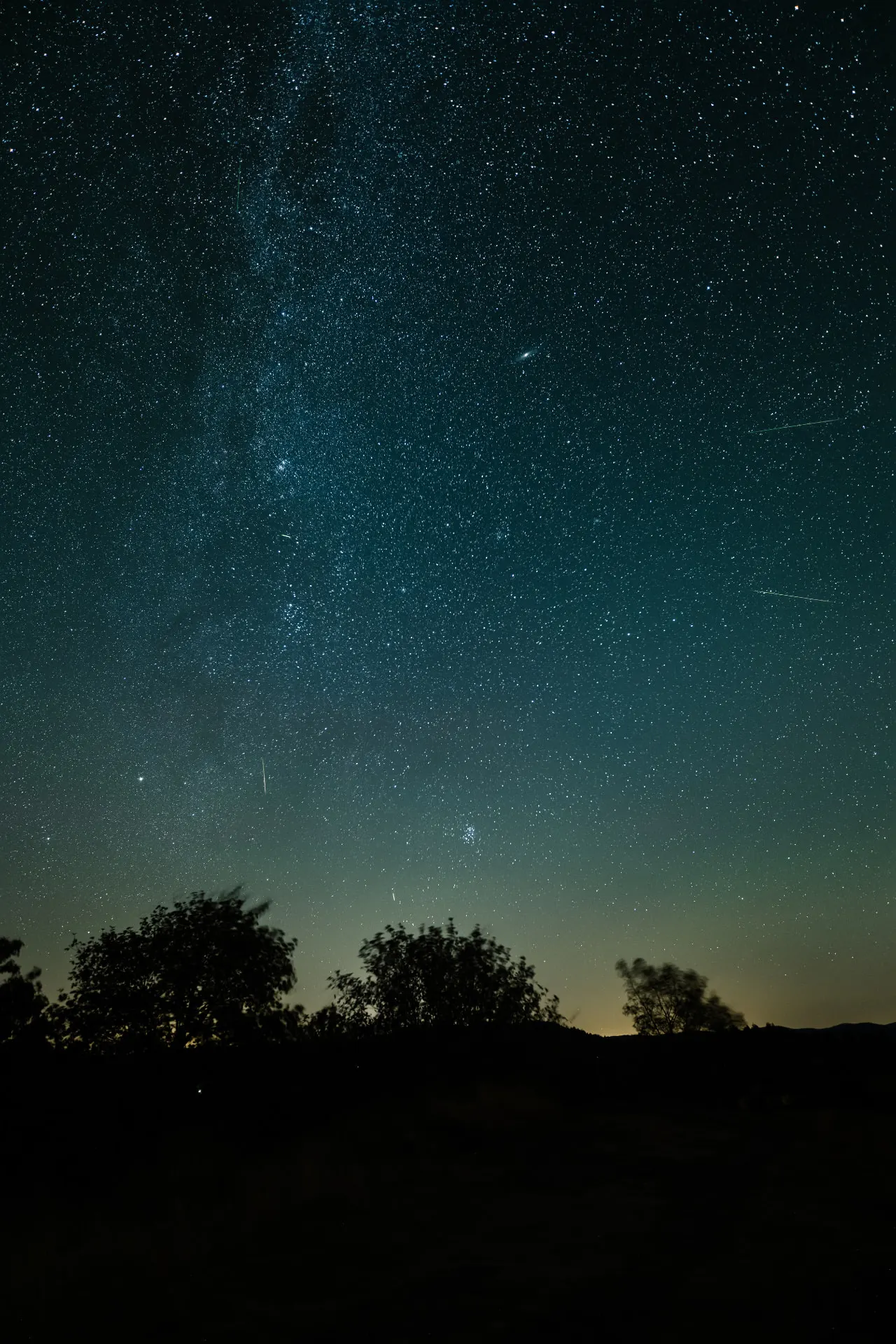
Then the meteors were pasted in, entirely by script. The hard part is not laying the images on top of each other. Between the frame with the meteor and the stack, the sky has turned. On a flat image, this rotation of the sky is corrected with a homography: a warp of the image set by eight parameters, not two. We fit it on the stars found in both images, refining it several times. Final residual (the gap left over): 1.44 to 1.77 pixels across the eight composites.
Then the check. Each trail is pasted inside a small disc of sky around it. I compared each of these discs with the same area of the bare stack:
| measurement | result |
|---|---|
| level added to the sky background (median) | +0.000 % |
| noise inside the composited zone, before → after | 4.62 % → 4.72 % |
| star shape (elongation), before → after | 1.62 → 1.63 |
In other words: no brighter disc, no visible seam, no doubled star. The composite adds the trails and touches nothing else. Without those three numbers, all I would have had is an impression.
One last measurement, less flattering. On the stack, the stars show an elongation of 1.89 at the centre of the frame. The centre is where a lens defect would be smallest. So it is not the lens: it is trailing. The stars moved during the exposure. At 16 mm on a 61 Mpx sensor, the NPF rule (a formula for the longest exposure before stars stretch) caps the exposure at about 11 s. I shot 13. Two seconds too many, baked into all 21 frames, impossible to fix. Next time: 10 s, and twice as many frames.
What the photograph holds
Then we did the astrometry: placing the image exactly in the sky. Two objects you can recognise in the frame, M31 and the Pleiades, are enough to lock that night's sky map onto the picture. The frame points east-north-east, centred 31° above the horizon, across a field of 74° × 97°.
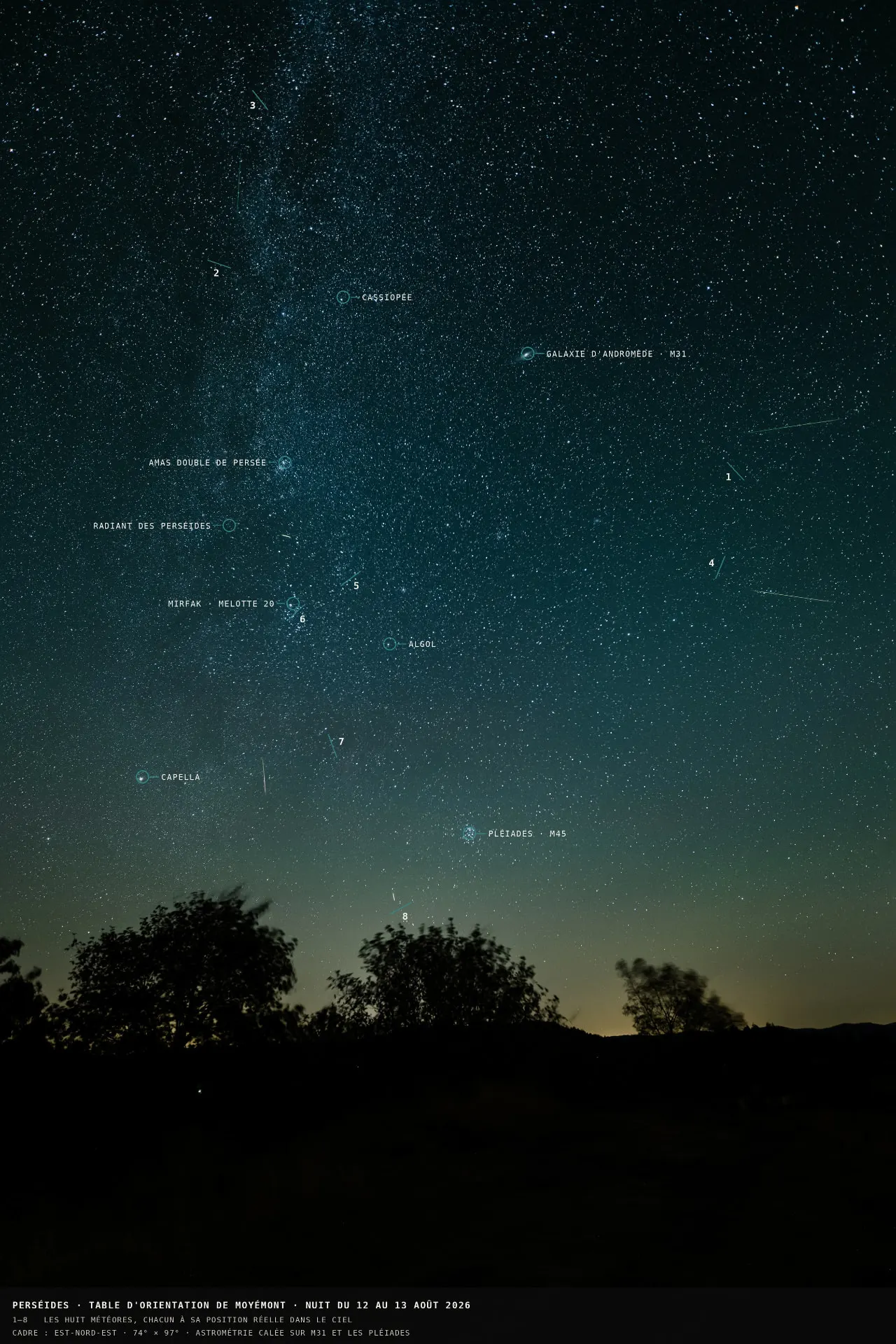
- The Andromeda Galaxy (M31): 2.5 million light-years away, the most distant object visible to the naked eye. You can see its dust lanes.
- The Double Cluster in Perseus (h and χ): twin open clusters, groups of stars, 7,500 light-years away.
- The Pleiades, rising, blue.
- Mirfak and the Melotte 20 association: the stream of stars running through Perseus.
- Algol, an eclipsing binary: one star passes in front of the other. Its brightness drops by half every 2.87 nights.
- Cassiopeia, its W across the top of the frame.
- Capella and Aldebaran, low on the north-eastern horizon.
- Uranus, magnitude 5.7 (a very faint brightness), just below the Pleiades. It is on the image, but you can only tell it from a faint star by comparing two frames an hour apart.
- And the Perseid radiant itself: the point all eight trails lead back to when you extend them backwards.
The other framing
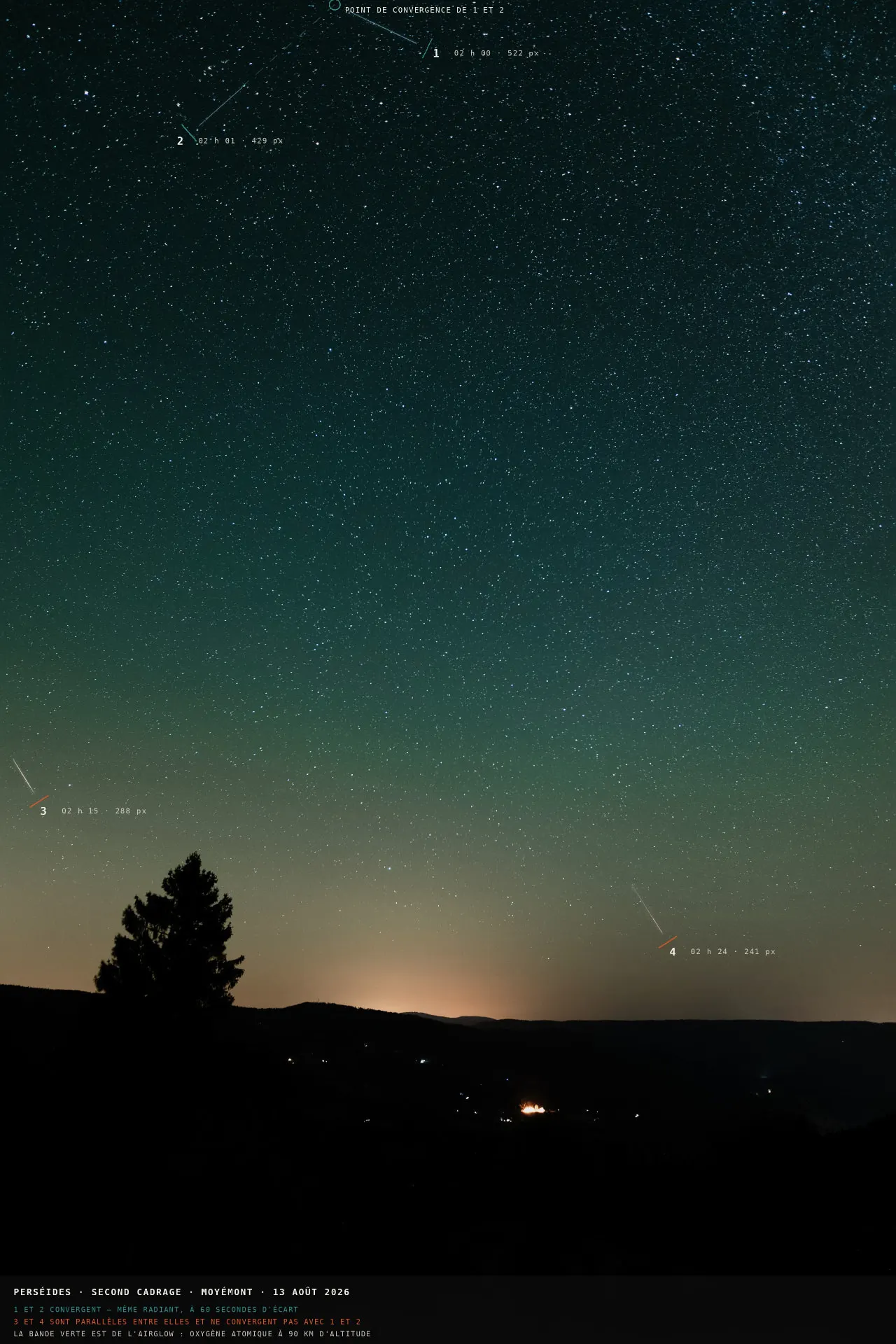
At two in the morning I turned the camera. A lone fir on the ridge, the valley below, and a higher patch of sky: less Milky Way, more emptiness. Four meteors fell into it between 2:00 and 2:25.
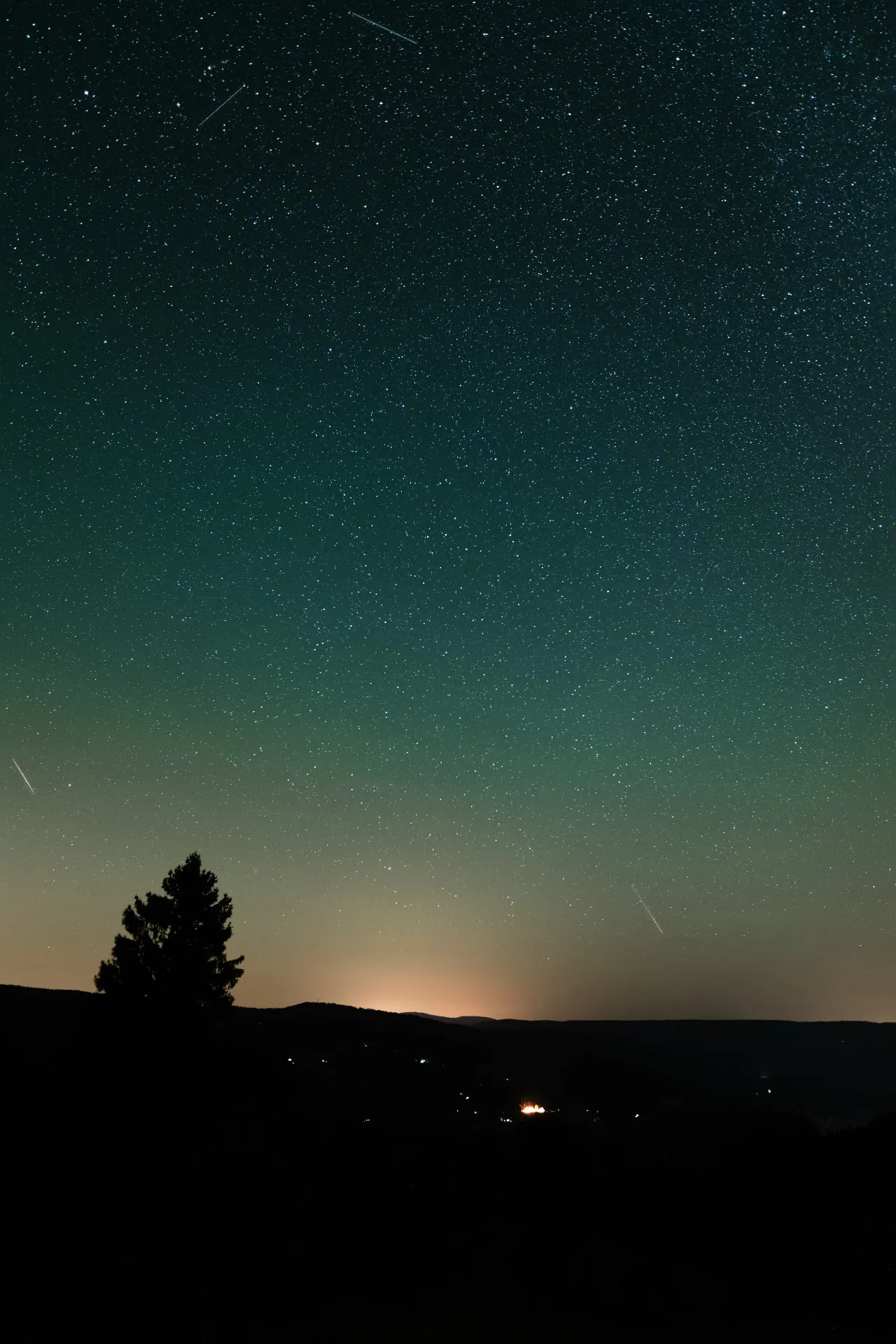
Same method: nothing moved, nothing taken from elsewhere. And an alignment twice as precise as on the first framing: 0.5 to 0.8 pixels against 1.4 to 1.8. Because these four frames are close in time to the stack that serves as their background. The sky turned less, so there is less to correct.
Two of these trails nearly went unfound. The first, at 2:00 exactly, is on the frame right after the six-minute pause. The detector had no neighbours left to compare it with. The second I spotted with my own eyes on the screen, two minutes later. The machine had let it through.
The three images
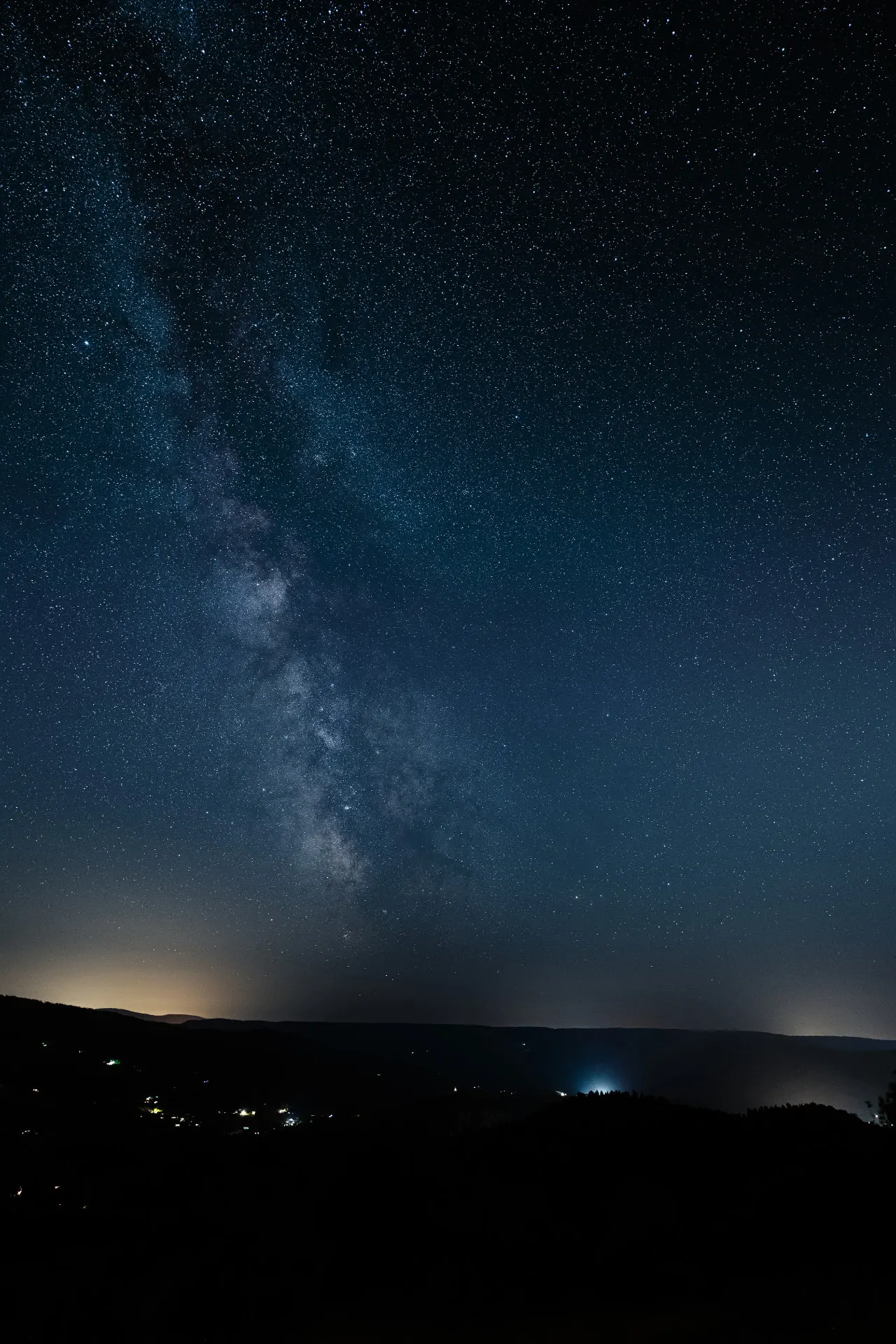
The first shows the centre of our galaxy, seen from the orientation table. One direction, one stack, nothing assembled.
The second is the composite: two hours of sky brought together in one image, eight meteors that never crossed paths.
The third is the same night, two hours later, turned toward another horizon. Four more trails, and a fir tree for scale.
One is an instant. The others are a night.
Sony A7R VI · Viltrox 16 mm f/1.8 at f/2 · 13 s · ISO 3200 · stacked in Starry Landscape Stacker · detection, alignment and compositing by Python scripts written with Claude · finished in Lightroom.